Matera ·
Matera: a town that was emptied and came back
Seventy years ago the cave districts of Matera were a national embarrassment, and the state moved their people out. Today the same rock houses hold hotels, a UNESCO listing and a year as European Capital of Culture, and the best way to understand the town is to keep both stories in mind.
Places
Two Sassi and the ridge between them
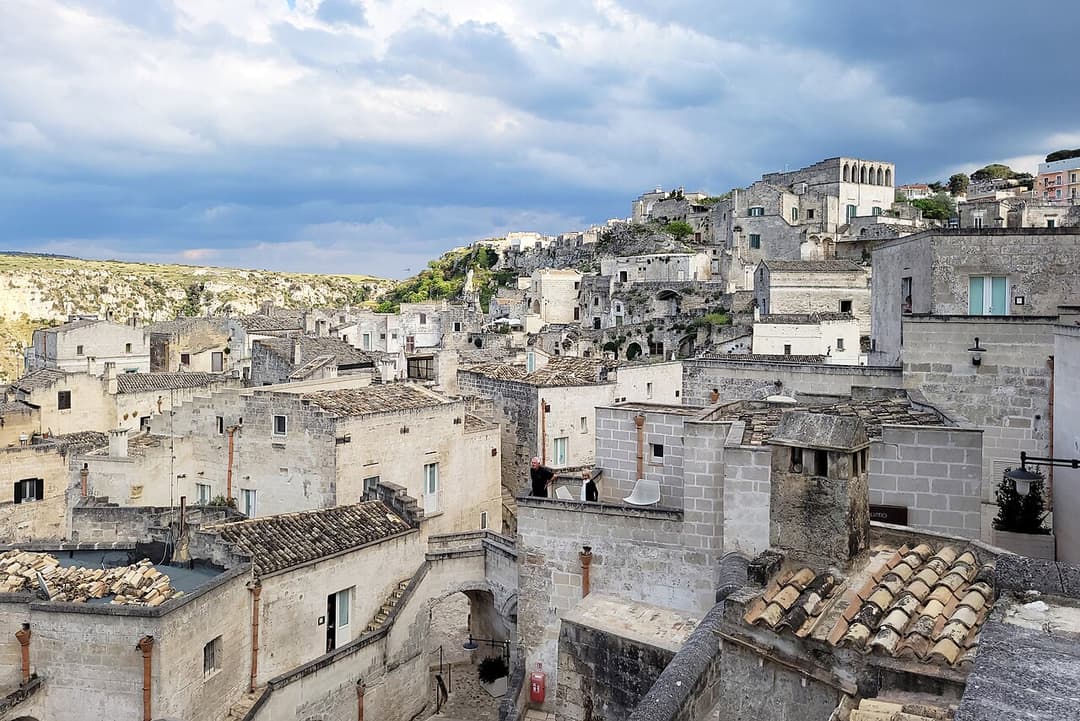
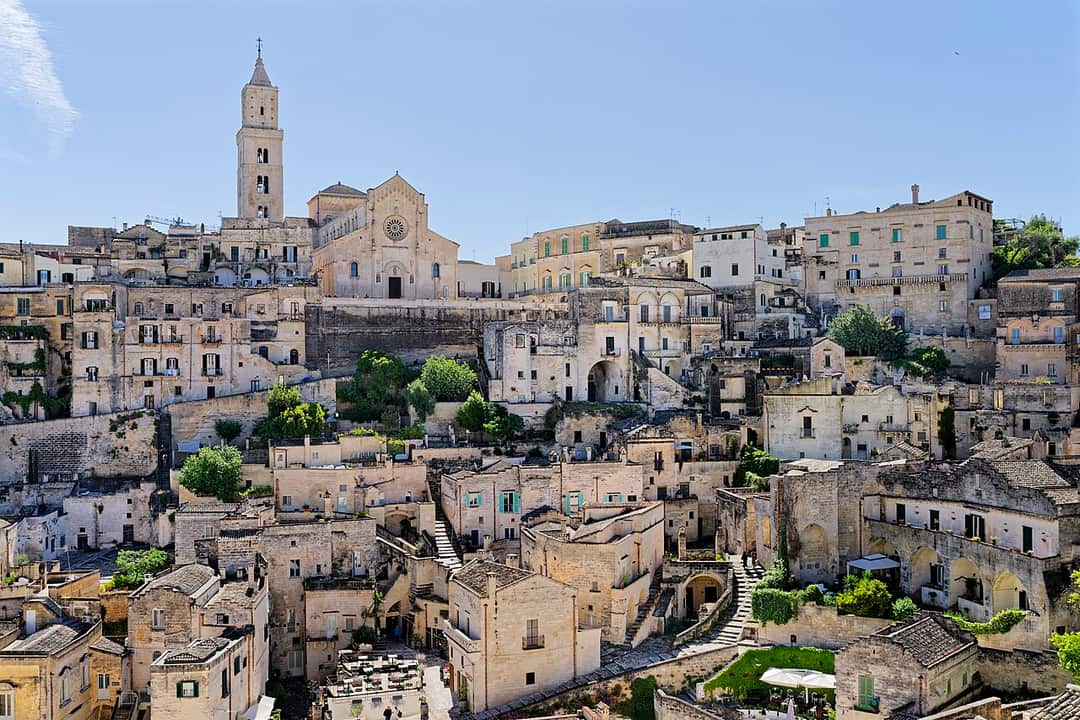
The old town is three parts: Sasso Barisano to the north, facing Bari, Sasso Caveoso to the south, and the Civita, the ridge between them that carries the cathedral. The houses are dug into the side of the Gravina ravine, and the slope has been lived in since the Palaeolithic. Water was the hard problem: channels fed drop-shaped cisterns, and some houses had as many as seven. Walk the Caveoso first; it is the steeper and the more cave-like of the two.
Sources: en.wikipedia.org · it.wikipedia.org
The cathedral at the top of the town
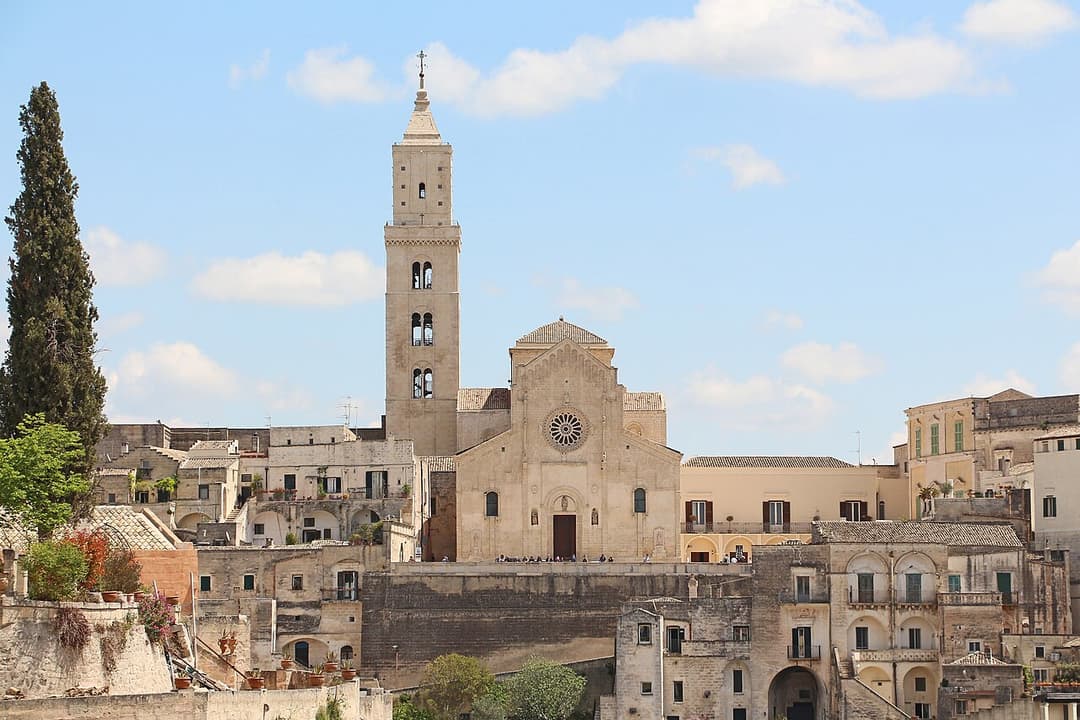
Matera Cathedral stands on the highest point of the town, on the ridge that divides the two Sassi. It was finished in 1270 in the Apulian Romanesque style, with a bell tower of 52 metres; sources disagree on whether building began in 1203 or 1230. Inside is a fresco of the Madonna della Bruna, the town’s patron, dated to 1270 and attributed to Rinaldo da Taranto. Recent restoration uncovered a fourteenth-century Last Judgement, which is worth looking for.
Sources: en.wikipedia.org
Palombaro Lungo, the cistern under the square
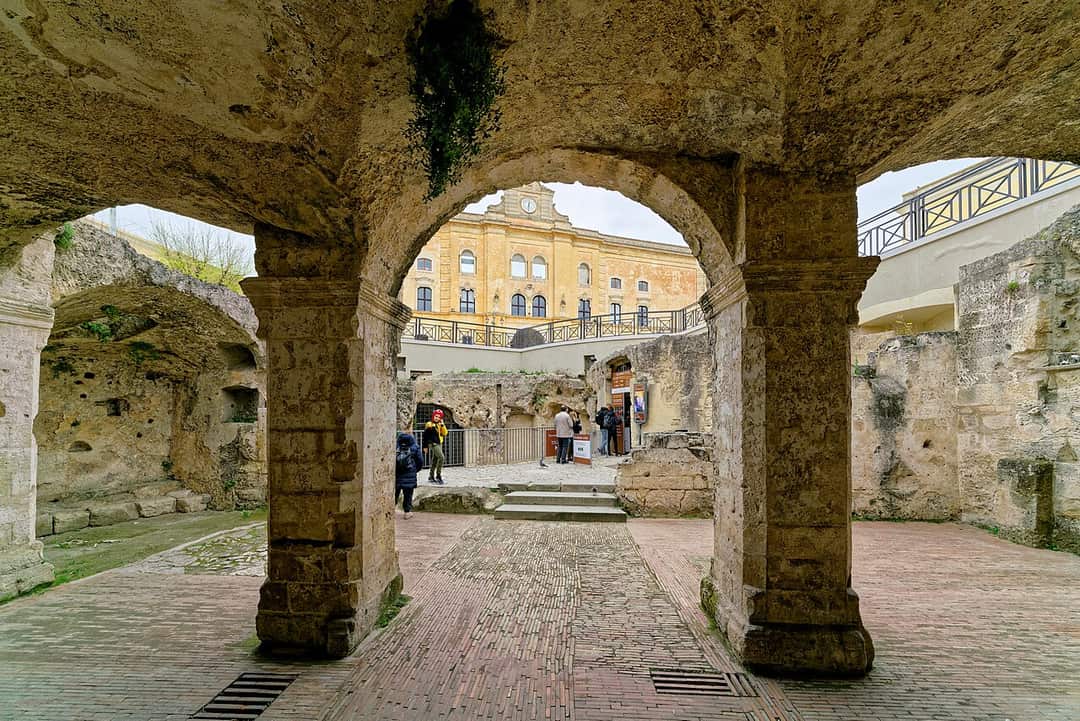
Beneath the paving of Piazza Vittorio Veneto lies the town’s largest cistern, more than fifteen metres high and able to hold about five million litres of rain and spring water. It grew out of older caves linked together; the completion date is given as 1832 in some sources and 1882 in others. It went out of use in 1927, when the Apulian Aqueduct reached Matera, and was rediscovered in 1991 by a group that crossed it in an inflatable boat. It explains the Sassi better than any viewpoint.
Sources: it.wikipedia.org · en.wikipedia.org
The Crypt of Original Sin
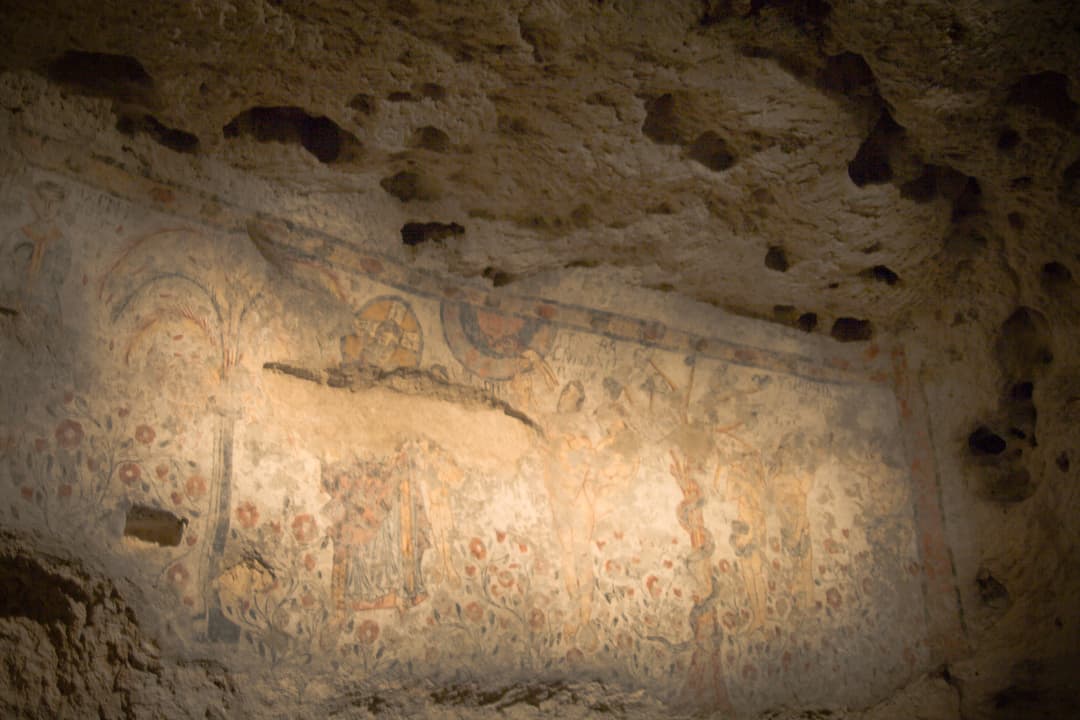
Outside the town, in the wall of the Gravina di Picciano, is the cave chapel of a Benedictine community from the Lombard period. Its frescoes date from the eighth and ninth centuries and are attributed to an unnamed artist known as the Painter of the Flowers of Matera. The back wall runs from the Creation to the Fall, which gives the crypt its name; the side wall holds the Apostles, the Virgin and the Archangels. It was rediscovered in May 1963, and visits are by appointment only.
Sources: italia.it · fondoambiente.it
Culture
From national shame to a special law
By the early twentieth century the Sassi had been declared unfit to live in, and about fifteen thousand people, half the town, still lived there amid poverty and malaria. Carlo Levi’s Christ Stopped at Eboli, published in 1945, turned national attention to the region, and politicians as far apart as Palmiro Togliatti and Alcide De Gasperi took up the case of Matera. A special law of 17 May 1952, passed unanimously, began the move to new districts. Restoration only started after a law of 1986.
Sources: it.wikipedia.org · italiaslowtour.com · en.wikipedia.org
La Martella, a village drawn for the evacuees
Adriano Olivetti, the industrialist, set up a commission with UNRRA-CASAS and the national planning institute to study Matera and its countryside. One result was La Martella, a rural village built in 1952–54 for landless families and the first people to leave the Sassi, designed by Ludovico Quaroni with Federico Gorio, Piero Maria Lugli, Luigi Agati and Michele Valori. Its church of San Vincenzo de’ Paoli has a majolica floor by the Cascella brothers. Go to see what the state promised in place of the caves.
Sources: it.wikipedia.org
Palazzo Lanfranchi and Levi’s great canvas
Archbishop Vincenzo Lanfranchi built the palace between 1668 and 1672 as the diocesan seminary; later it housed the town’s classical lycée, where Giovanni Pascoli taught from 1882 to 1884. Since 2003 it has been the national museum of medieval and modern art of Basilicata. The room to find is the one with Carlo Levi’s Lucania ’61, painted for the 1961 exhibition in Turin that marked a century of Italian unity and built around the Lucanian poet Rocco Scotellaro. Read it after the Sassi, not before.
Sources: it.wikipedia.org · arte.it · artribune.com
The Bruna and the chariot built to be destroyed
On 2 July Matera honours the Madonna della Bruna. The date goes back to a decree on the feast of the Visitation prepared in 1389 by Urban VI, a former bishop of Matera, and promulgated in 1390 by Boniface IX. Each year a new papier-mâché chariot is made, its central scene chosen by the bishop. In the evening, after the procession, the crowd tears it apart and carries off the pieces. Legend says the custom began to keep a painting of the Madonna out of the hands of Saracen raiders.
Sources: sassiweb.it · en.wikipedia.org
Food and drink
Pane di Matera and the family stamp
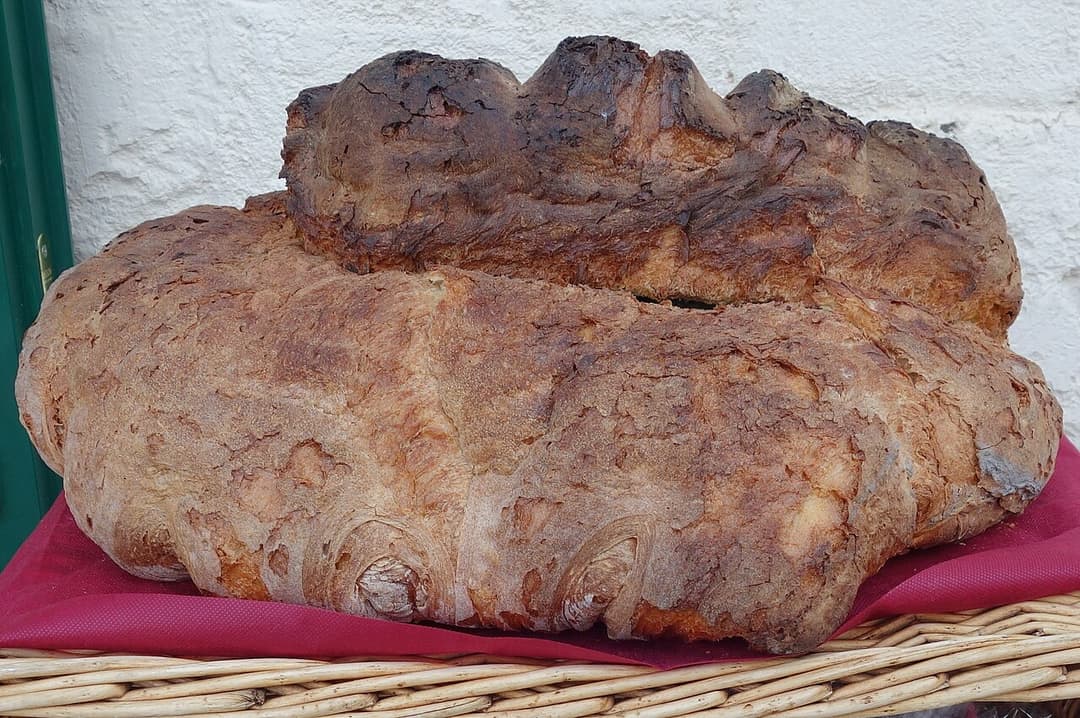
Matera’s bread is made from re-milled durum wheat semolina and has been a protected geographical indication since 2008; its shape is said to recall a small hill of the Murgia. Until 1950 families pressed a wooden stamp into the dough before baking so they could recognise their own loaf afterwards. The stamps were carved by shepherds while they were out with the flocks, and many are now in the Domenico Ridola archaeological museum. Buy a loaf in the morning and let it be your lunch.
Sources: italia.it · en.wikipedia.org
Peperoni cruschi, the pepper that crackles
Crusco means crisp. The sweet peppers of Senise, protected since 1996, are dried in the sun on strings one and a half to two metres long, then given a short spell in the oven. The result is an essential ingredient of Lucanian cooking: whole and crisp, or ground into a red powder that locals compare to saffron. If a menu offers something con peperoni cruschi, order it.
Sources: it.wikipedia.org
Crapiata, a soup made by everyone
Crapiata is the peasant dish of the Sassi: chickpeas, grass peas, beans, broad beans, lentils, wheat and new potatoes, cooked together with salt as the only seasoning. Its point was the new harvest and the act of sharing, since each household put in what it could. It is traditionally made on 1 August, with music and dancing. Outside that day, ask for it as a reminder of how little the Sassi had to work with.
Sources: it.wikipedia.org
Things to do
Cross the Gravina to Murgia Timone
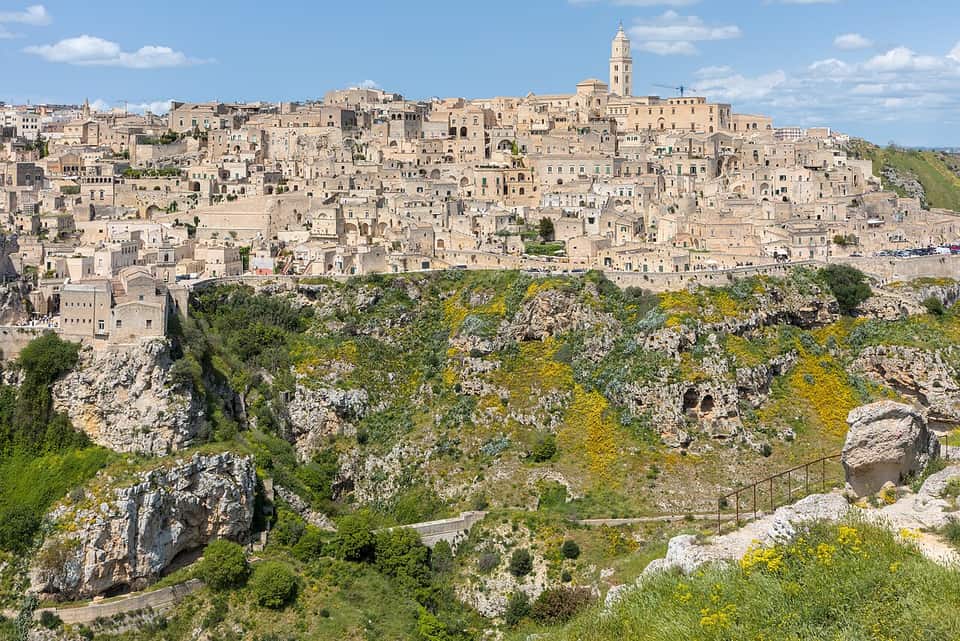
The best view of Matera is from the other side of the ravine. Path 406 starts at Piazza Vittorio Veneto, goes down the steps to Porta Pistola, crosses the Gravina on a wooden bridge and climbs to the Murgia Timone viewpoint. Up there are a Neolithic village and rock churches such as ninth-century San Falcione; the regional park, founded in 1990, holds about 150 of them. Go early in the morning or at sunset, and take water.
Sources: italia.it · en.wikipedia.org
Start at Casa Noha
Casa Noha is a small Materan house within the sixteenth-century Palazzo Noha, in the Civita near the cathedral, given to the Italian heritage trust FAI in 2004 by the Fodale and Latorre families. It is not a museum. In two ground-floor rooms a film narrated by the actress Lella Costa tells the town’s story in two chapters, from its origins to 1945 and from 1945 to today. See it on your first morning; everything after makes more sense.
Sources: fondoambiente.it
Craco, the town the hill gave up
Craco, in the province of Matera, began to be evacuated in 1963 after a series of landslides, and its people moved down to the valley. A flood in 1972 made things worse, and after the Irpinia earthquake of 1980 the hilltop town was abandoned altogether. Film crews have used it ever since, for Christ Stopped at Eboli in 1979 and Quantum of Solace in 2008 among others. It is a car trip from Matera; find out how visits are organised before you set off.
Sources: en.wikipedia.org
Tips
Arrive by the narrow-gauge train
Matera is the end of the line on the Bari–Matera railway, a narrow-gauge route run by Ferrovie Appulo Lucane that first reached the town in 1915. The nearest airport is Bari. The slow ride across the Murgia is a good introduction to the landscape the town is cut from, so it is worth taking at least one way.
Sources: it.wikipedia.org · en.wikipedia.org
Walk down, not up
The Sassi are stairways and lanes cut into a slope, so plan your walks from the top. Begin on the Civita by the cathedral, go down through one Sasso and come back up through the other. Wear shoes with a good grip and save your places on an offline map before you set off.
Sources: en.wikipedia.org · it.wikipedia.org
Getting online
Mobile data helps with maps in the lanes of the Sassi, with train timetables and with booking visits such as the Crypt of Original Sin. A Roamy eSIM for Italy can be installed before the trip and switched on when you land in Bari. Download an offline map of the town as well, in case the signal drops.
Sources: en.wikipedia.org