Tbilisi ·
Tbilisi: a city named for its warm water
Tbilisi takes its name from tbili, warm, and the old city still gathers around the sulphur springs at the foot of Narikala, with the Mtkvari cutting below. Sacked in 1795 and rebuilt under Russian rule, it is a sixth-century church, a Swabian village turned avenue and a puppet theatre's crooked tower within a short walk of each other, and a table that runs on toasts.
Places
Abanotubani, where the city began
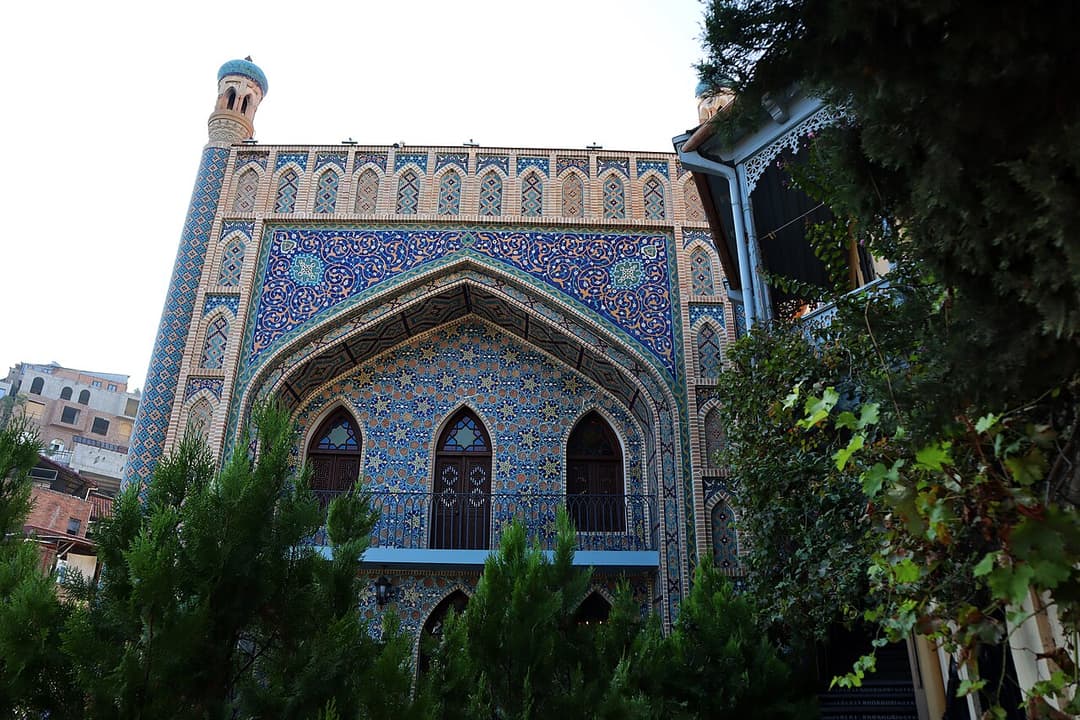
The founding legend puts King Vakhtang Gorgasali's hawk and a wounded pheasant in a boiling spring in the fifth century, and the springs are still here, in Abanotubani, the bath district below Narikala. The brick domes at street level are the roofs of bathhouses set underground; Chreli Abano, the colourful bath, is the exception, standing above ground behind a tiled façade. The national tourism board counts sixty-five baths in the twelfth century and six by the nineteenth. Alexandre Dumas, here for over a month in 1858, left worried that Paris would have nothing like them.
Sources: georgia.travel · lonelyplanet.com
Narikala, and the mother on the ridge
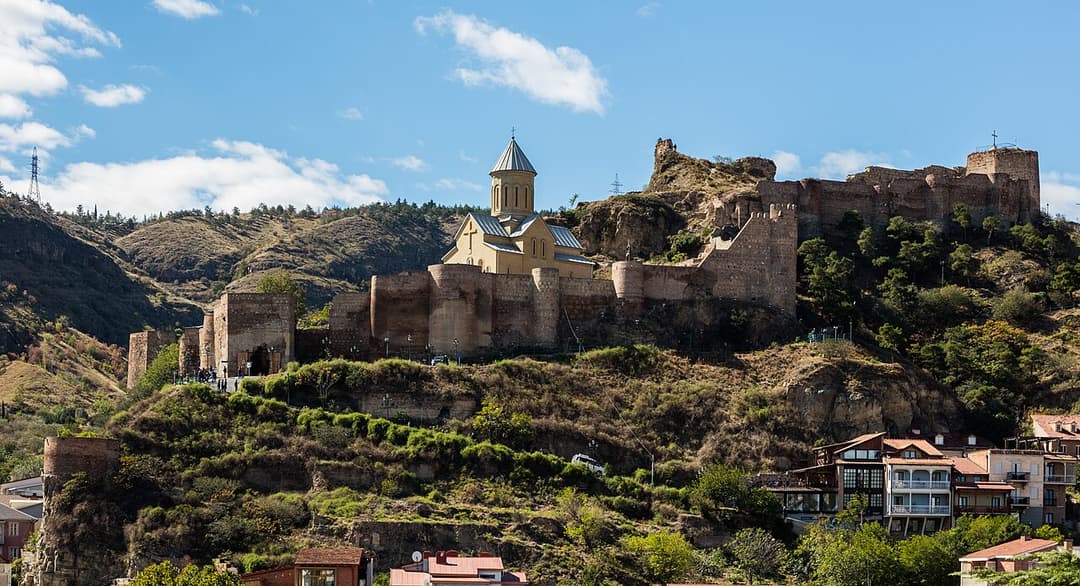
A fort stood on the ridge above the baths by about 364; the Umayyads enlarged it, so did David the Builder, and the Mongols called it Narin Qala, the little fortress. Most of the walls are sixteenth and seventeenth century, and the church of St Nicholas inside was rebuilt in 1996–97. Further along the ridge stands Kartlis Deda, the Mother of Georgia, put up in 1958 for the city's 1,500th anniversary. She holds a bowl of wine for those who come as friends and a sword for those who do not. Walk up from the baths and follow the ridge west.
Sources: en.wikipedia.org · en.wikipedia.org
Metekhi, the church on the cliff
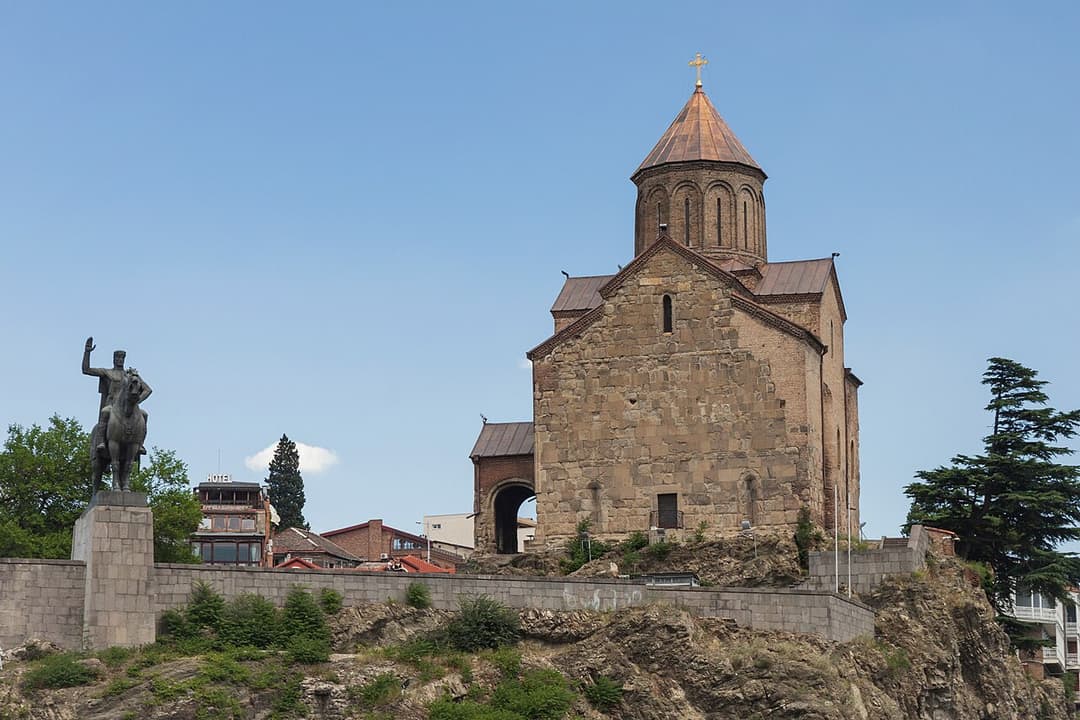
Across the river from the baths, Metekhi church stands on a cliff above the Mtkvari, built by King Demetrius II around 1278–1284 on ground tradition gives to Vakhtang Gorgasali's palace. Its later life is the city's in miniature: barracks under Russian rule, a prison beside it until 1938, a theatre in the late Soviet years and a church again from 1988. When Beria wanted it pulled down in the 1930s, the painter Dimitri Shevardnadze led the intellectuals who objected and was executed for it; the church survived. The equestrian Gorgasali in front dates from 1961. Come for the view back across the river to Abanotubani.
Sources: en.wikipedia.org
Sololaki, the city the Russians laid out
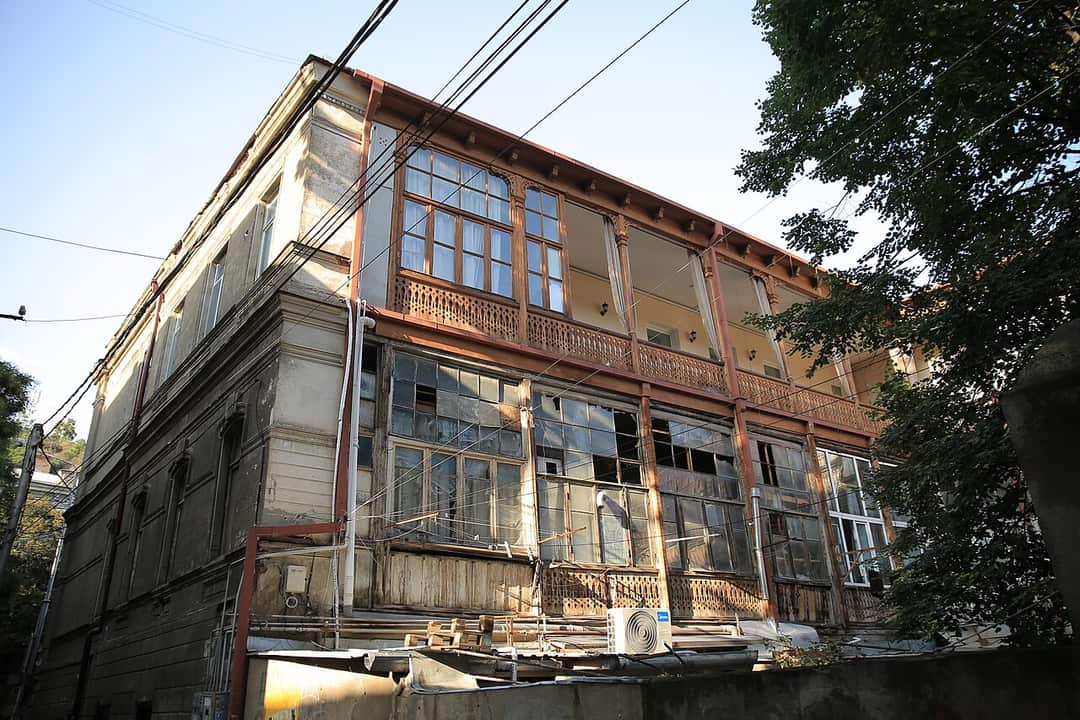
Almost nothing of pre-nineteenth-century Tbilisi survived the Persian sack of 1795, so most of the old city you walk through belongs to the Russian imperial century that followed. Sololaki, on the slope of Mtatsminda, shows it best. Before the name appeared in the nineteenth century these were the gardens of Georgian nobles, and building took off in the first half of that century, with the stretch of today's Leonidze Street and Freedom Square laid out in 1847–51. The street fronts are European; step into the courtyards, where the open, carved wooden galleries Old Tbilisi is known for still hang behind them.
Sources: en.wikipedia.org · en.wikipedia.org
Aghmashenebeli Avenue, once a Swabian village
On the left bank, the avenue named after David the Builder began as Neu-Tiflis, a village of German craftsmen founded around 1818 by Swabians from Württemberg. By the tourism board's account it joined the city in 1862, and its main street, named after Grand Prince Mikhail, was by the 1890s an address for hotels, clubs and the houses of rich merchants; Leo Tolstoy lived here for a time and Fyodor Chaliapin began his career here. The Lutheran church at the colony's centre, on today's Marjanishvili Square, was demolished after the Second World War. Little German building is left, but walk into the green inner courtyards the colonists' gardens became.
Sources: georgia.travel
Culture
Anchiskhati, the oldest church in the city
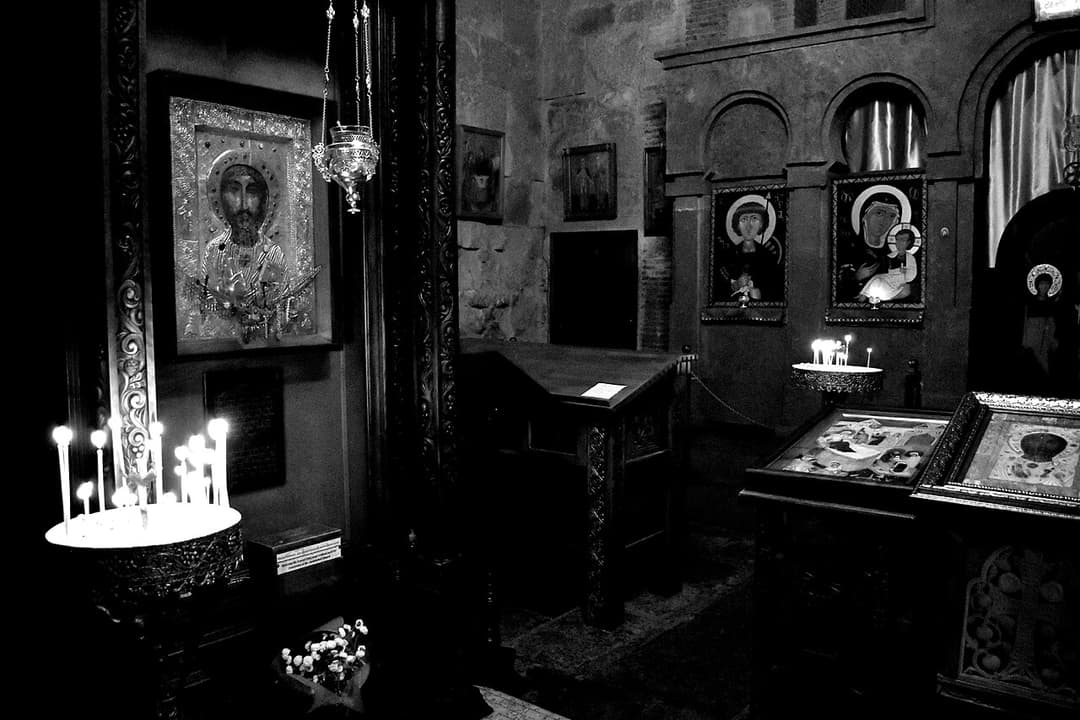
Tbilisi's oldest surviving church is a sixth-century basilica that the Georgian annals credit to King Dachi, the ruler who made the city his capital. It was built for the Virgin and took its present name in 1675, when an icon by the twelfth-century goldsmith Beka Opizari was brought from the monastery of Ancha in Klarjeti, now in north-eastern Turkey, to keep it from Ottoman invasion. A dome was added in the 1870s; the restoration of 1958–64 took the building back to its seventeenth-century form. The church's choir is among the leading voices of Georgian polyphony, so stay if a service is sung.
Sources: en.wikipedia.org
Rezo Gabriadze's crooked clock tower
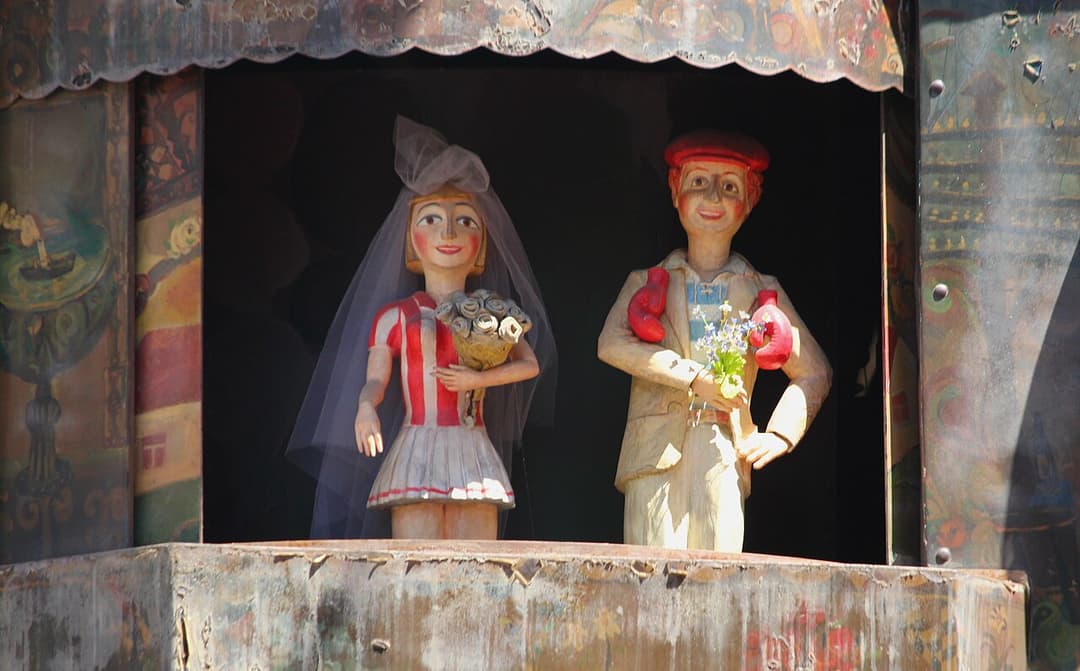
Rezo Gabriadze co-wrote the films Mimino and Kin-dza-dza!, then, frustrated by the lack of intellectual freedom in the Soviet Union, turned to marionettes and in 1981 founded his own theatre. It seats eighty, and its productions have toured from Edinburgh to New York. Since 2010 a leaning clock tower built from his sketches has stood beside it on Shavteli Street, faced with ceramic panels he made; every hour an angel steps out of a painted door to strike the bell. On the façade, in gold letters, runs his motto in Latin: let tears flow only from chopping onions. Book a performance rather than stopping at the tower.
Sources: gabriadze.com · en.wikipedia.org
Mtatsminda, a hillside of writers
On the slope of Mtatsminda, the holy mountain, the churchyard of St David holds the pantheon where Georgia buries its writers and public figures. It began with a marriage: the Russian playwright Alexander Griboyedov, who died in 1829 while serving as ambassador, was buried here, and his Georgian wife Nino Chavchavadze joined him in 1857. The pantheon was formally opened in 1929, on the centenary of his death, and in the 1930s the Soviet state moved Vazha-Pshavela and Nikoloz Baratashvili here from another cemetery. Who lies beside whom has been argued over ever since. Go up from Sololaki and look back over the old city.
Sources: en.wikipedia.org
One language, three alphabets
Georgian has its own script, and in fact three of them, sharing the same letter names and order. Asomtavruli, the oldest, and Nuskhuri are kept mainly by the Church, in inscriptions, icons and religious texts; everyday Georgian is written in Mkhedruli, from the word for horseman. Its oldest known inscription dates from 982, and it became universal outside the Church only with printed type in the nineteenth century. UNESCO inscribed the living culture of the three scripts in 2016. In Tbilisi you will meet the old capitals on church walls and Mkhedruli on every shop sign, so learn a few letters before you go.
Sources: en.wikipedia.org
Food and drink
Khinkali, eaten by hand
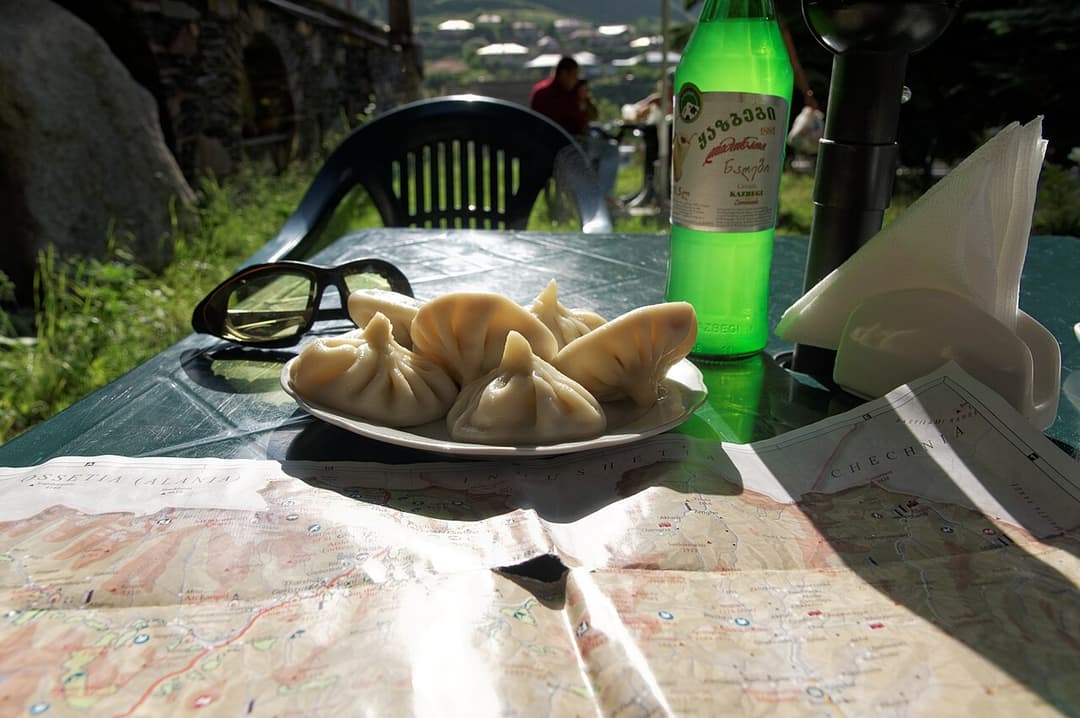
Khinkali are dumplings from the mountains of eastern Georgia, credited to the Mokhevians, Pshavians, Mtiuletians and Khevsurians. The meat goes in raw, so it cooks in its own juice inside the pleated dough. Hold one by its knot, bite a small hole, drink the broth, then eat the rest; a fork is considered childish, because it spills the juice. The knot, the kudi or tail, is too tough to eat and stays on the plate, where the pile tells the table how many each person has had. The mountain filling is meat, onion, chilli, salt and cumin; the city version, kalakuri, adds parsley and coriander.
Sources: en.wikipedia.org
Khachapuri, one bread for every region
Khachapuri, leavened bread filled with cheese, is Georgia's national dish and since 2019 part of its listed intangible heritage. Every region bakes its own. Imeruli, round and filled with salted Imeretian cheese, is the everyday one, and Megruli adds more cheese on top; Adjaruli, from the Black Sea coast, is a boat of dough holding cheese, butter and an egg yolk, read as boat, sea and sun. It is staple enough that economists at Tbilisi State University use it for a khachapuri index of inflation. Start with Imeruli and keep the Adjarian boat for a hungry day.
Sources: en.wikipedia.org
The supra, and who holds the glass
A supra, literally a tablecloth, is the Georgian feast, and it runs on toasts. A tamada, chosen by the guests or the host, proposes each toast and speaks to it; the others raise their glasses, add their own words in turn and drink. Eating during a toast is fine, talking over one is not. The form is younger than it looks: the word comes from Persian sofre, and historians date the modern ritual to the nineteenth century, though feasting and wine run through medieval Georgian literature. If you are invited, follow the tamada and pace yourself.
Sources: en.wikipedia.org
Qvevri, wine made underground
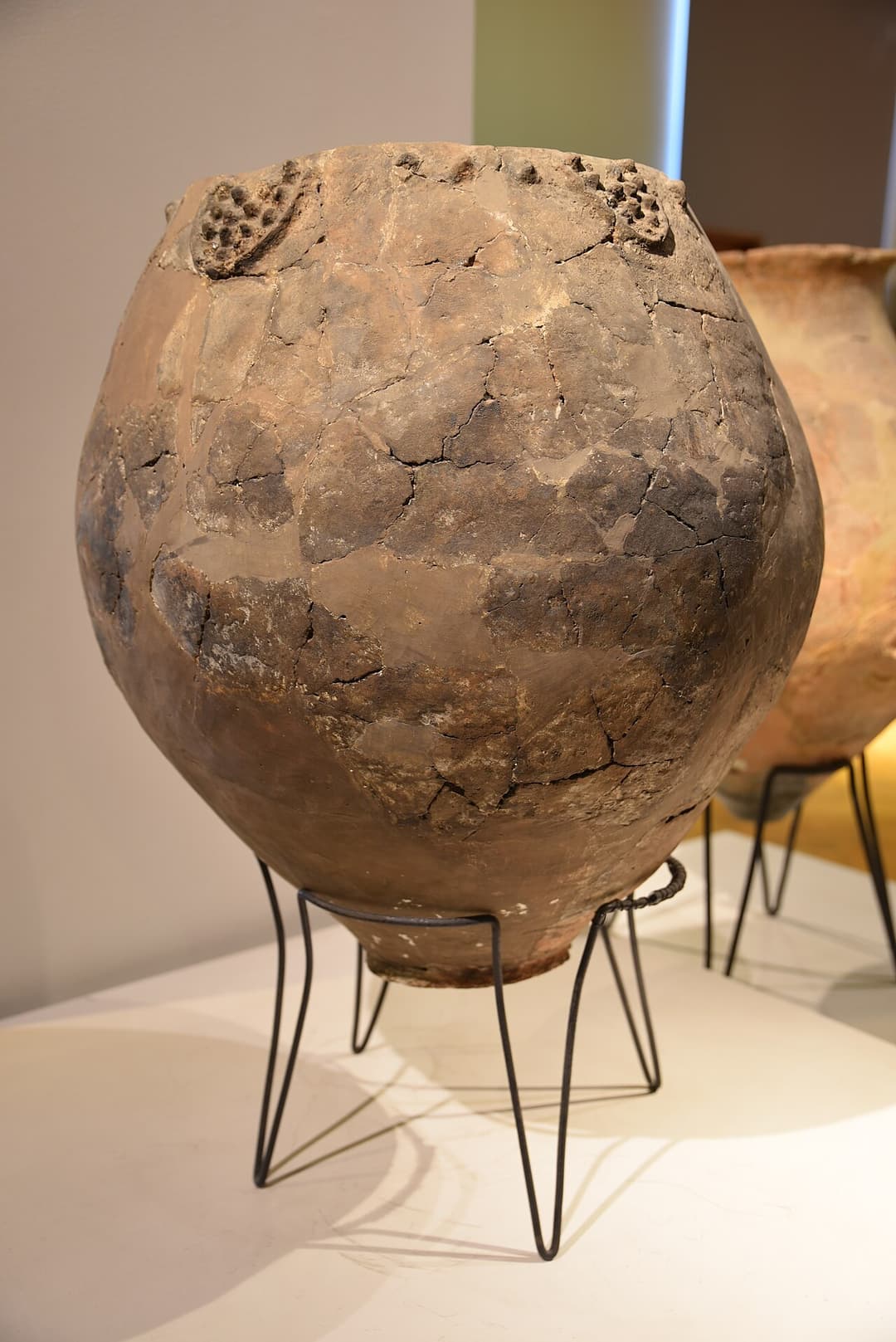
Traditional Georgian wine is made in qvevri, egg-shaped clay jars buried in the ground up to the neck. Grape pips and qvevri found in Kvemo Kartli, south of Tbilisi, go back to the sixth millennium BC, and UNESCO inscribed the method in 2013. Juice, skins, stalks and pips are sealed in together for at least five or six months; white grapes made this way, the Kakhetian method, give the amber wine Georgia is now known for, and what is left is distilled into chacha. The National Museum in Tbilisi shows a Neolithic qvevri decorated with bunches of grapes, worth seeing before you order a glass.
Sources: en.wikipedia.org · en.wikipedia.org
Tips
Take the metro, then walk the slopes
Tbilisi's metro opened on 11 January 1966, the fourth in the Soviet Union after Moscow, Leningrad and Kyiv, and today runs two lines with twenty-three stations. Like other Soviet-built systems, most stations are very deep, so allow for a long escalator ride. You pay with a Metromoney card, a stored-value card sold at the stations; buy one on the first day and top it up as you go. For the old town itself, get off at Liberty Square and walk, because from there everything is slopes and stairs.
Sources: en.wikipedia.org · en.wikipedia.org
Getting online
Mobile data earns its keep in Tbilisi. The old town is a tangle of levels on both banks of the river, Mtatsminda and the botanical garden lie up the hill, and buses and taxis are easier to work out with an app. A Roamy eSIM for Georgia can be installed before you leave and switched on when you land. Download an offline map of the old town too, for the stairs and courtyards where the signal drops.
Sources: en.wikipedia.org · en.wikipedia.org